
Reed’s Fuel & Trucking
By partnering with SAIF’s experts, the trucking company significantly improved safety and reduced costs.
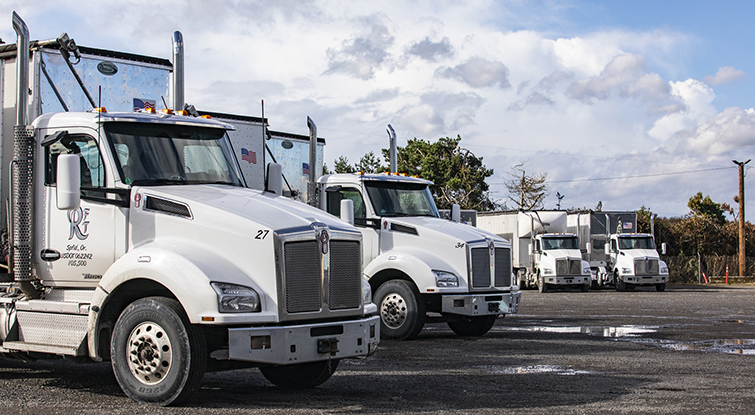
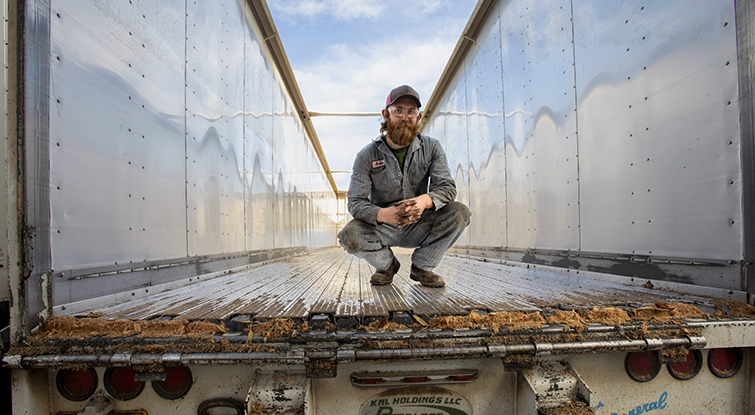

About six years ago, some 90% of Reed’s Fuel & Trucking workers’ compensation claims were for shoulder injuries caused by workers manually cranking heavy tarps to cover trucks. Now, such injuries have decreased dramatically—along with the company’s workers’ compensation insurance costs.
The turnaround happened because Troy Corwin, vice-president, and Jason Reed, president and co-owner of Reed’s Fuel & Trucking, turned their passion for safety into a rewarding partnership with SAIF.
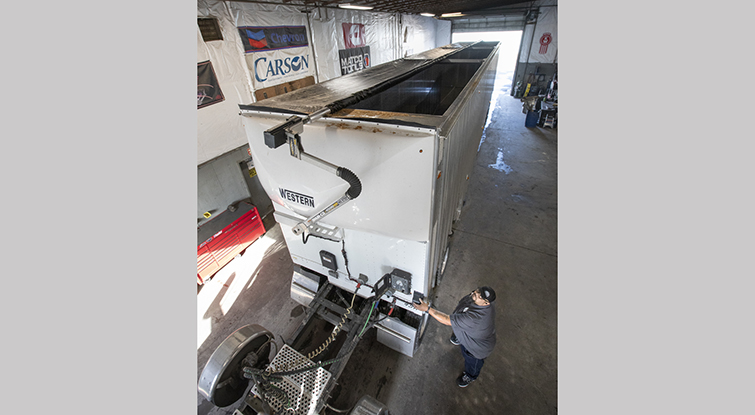
SAIF’s return-to-work experts helped Reed’s Fuel & Trucking access funds from the State of Oregon’s Employer-at-Injury-Program (EAIP) to pay for an electric system that rolls the truck tarps. Instead of cranking the equipment by hand, workers now simply push a button. They avoid injuries, and the work takes place more quickly and efficiently.
Corwin urges other policyholders to take advantage of the many free resources that SAIF offers. He’s taken safety and health classes, meets with his safety consultant, and communicates regularly with claims adjusters. He refers to SAIF return-to-work consultant Karin Helikson as his “sensei” for teaching him the ins-and-outs of workers’ compensation.
“SAIF really helped me look at things differently,” says Corwin, who’s also given presentations at SAIF workshops and events.
Using technology to enhance safety
Although the company name bears witness to its early history of transporting firewood and household fuel oil, Reed’s Fuel & Trucking now primarily transports wood products such as sawdust, wood chips, and hog fuel. Trucks pick up loads from 365 wood mills in Oregon and deliver them to manufacturing facilities that convert them to products such as toilet paper, liner board for cardboard boxes, electricity, particle board, wood pellets, and soil mixtures for landscaping.
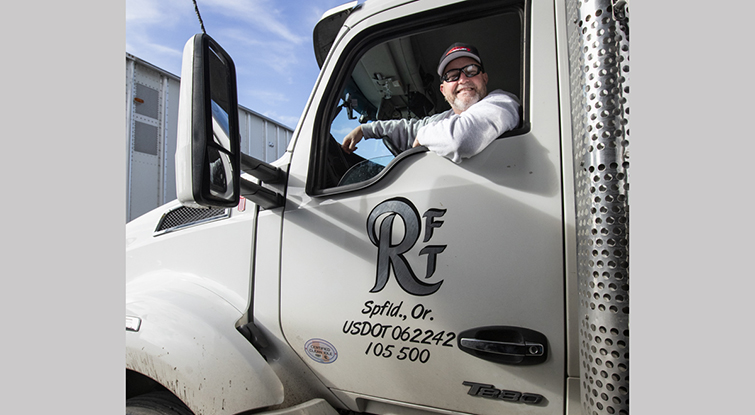
With 95 employees and 42 trucks, Reed’s Fuel & Trucking runs 24 hours a day, 365 days a year. Its 48- and 53-feet trucks are serviced in-house every 3,000 miles, and the company regularly purchases new fleet vehicles (its oldest truck is from 2020) to take advantage of new safety technologies.
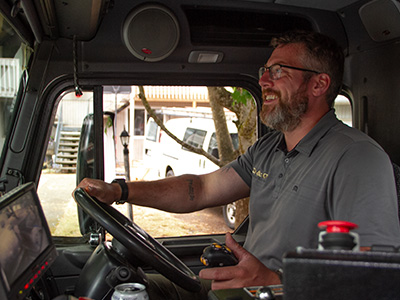
Over the years, the company has moved from stick-shift vehicles to automatics. A computerized GPS system shows trucks’ locations at all times. Cameras, digital mirrors, and other equipment on the vehicles monitor speed and road positioning. Reed’s Fuel & Trucking has a strict policy against its drivers speeding, hard braking, or tailgating.
Commitment to protecting workers
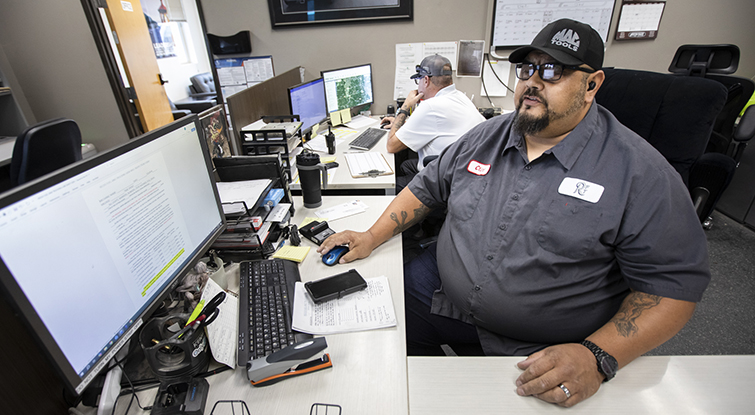
The tarping system is just one of the creative and proactive ways Reed’s Fuel & Trucking has helped its workers. Corwin used EAIP funds to purchase a washer-dryer set, so injured workers on light duty could clean the mechanics’ overalls, which used to be sent to a laundry. EAIP funds also paid for backpack leaf blowers so employees on light duty could do grounds maintenance at the company’s offices. Other workers on modified duty have learned computer programs to track truck drivers’ electronic logs, gaining new skills along the way.
“We want to get our injured workers back to work so they feel comfortable. We give them work that’s not demeaning and gives them positive feelings of self-worth,” says Corwin. “To us, workers aren’t a number, they’re a person. And we’ll do everything to make them safe and comfortable at work.”
Corwin started at Reed’s Fuel & Trucking as a truck driver 34 years ago. He went on to work in the shop and in dispatch before working his way up to co-own the company. He credits his partnership with SAIF with helping him improve the company’s safety record to the point that it now has some of the fewest claims for a company of its size in the industry.
“I appreciate SAIF’s safety and health culture, and it’s what I try to bring into our company,” he says.
As the company’s website proudly notes, “Our co-workers’ safety is ALWAYS our main concern.” In practice, that includes developing written safety policies, holding monthly safety meetings, and taking classes on ergonomics and leadership. But, with truckers on the road or visiting other companies’ properties, safety is sometimes out of the company’s hands. When a worker is injured, Reeds’ Fuel & Trucking aims to help.
One innovation was developing a return-to-work packet for injured workers. New employees receive a packet when they join the company, and both the night- and day-shift supervisors have them for whenever an incident should occur.
Developed with the help of SAIF’s return-to-work consultant Karin Helikson, the packet contains all the information and paperwork that injured workers and their medical providers need. With generic job descriptions for modified work and a copy of the company’s return-to-work policy, it clearly sets out Reed’s Fuel & Trucking’s commitment to helping injured workers return to work wherever possible.
“I don’t think some employers know how to talk to injured workers, but SAIF does that all the time,” Corwin adds. He advises other companies to “go in and be a sponge—take advantage of their expertise. Doing what SAIF advised us to do really helped turn our company around.”